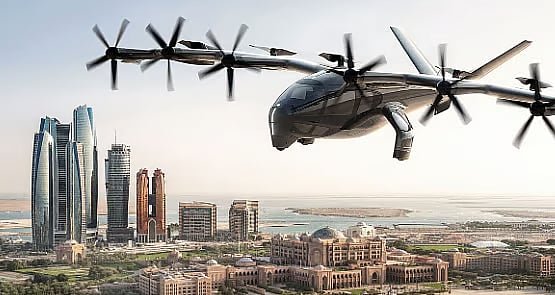
Abu Dhabi Takes Flight: Successful Flying Taxi Test Marks Bold Leap Toward Aerial Mobility
From test flight to takeoff: Abu Dhabi accelerates aerial mobility with climate-resilient tech, public-ready pricing, and a full ecosystem to support flying taxi services by 2026.
With a focus on commercial readiness, climate resilience, and ecosystem development, Abu Dhabi sets its sights on launching public flying taxi services by 2026.
In a major milestone for urban air mobility, Abu Dhabi has successfully conducted its first test flight of a flying taxi at Al Bateen Executive Airport, marking a significant step toward launching commercial aerial transport by early 2026. The flight, performed by US-based Archer Aviation in collaboration with the Abu Dhabi Investment Office (ADIO), comes amid rising regional momentum for flying taxis, with Dubai also recently completing a similar trial.
“Today is the first step of many steps that are going to happen to enable the commercialisation of air taxis in Abu Dhabi and the UAE,” said Omran Malek, head of autonomous mobility and robotics at ADIO. “We don’t just test to test, but test to commercialise.”
The vertical takeoff and landing (VTOL) flight featured Archer’s Midnight aircraft, which is expected to be the first commercially deployed model. According to Dr. Talib Alhinai, manager of Archer Aviation UAE, the test aimed to evaluate the aircraft’s performance in the region’s unique climate conditions — including extreme heat, humidity, and dust — which are crucial factors for safe and sustained operations.
“Our initial test flights are focused specifically on validating our readiness for deployment in the UAE,” Alhinai said. “Once we assess performance in these conditions, we’ll be able to expand the flight test programme and prepare for commercial roll-out.”
The test programme will continue through the summer months, with commercial trials expected to follow. Archer plans to initially deploy a small fleet in Abu Dhabi, with broader expansion on the horizon. Importantly, manufacturing of the flying taxis is also slated to begin in 2027 at a facility in Al Ain, with ambitions to export to regional markets that have expressed growing interest.
Crucially, Abu Dhabi’s approach goes beyond aircraft deployment. Malek emphasized that the emirate is building a comprehensive ecosystem around the flying taxi industry. This includes developing vertiports, integrating with local airspace systems, and even launching pilot training and maintenance programmes in partnership with local universities.
“We are also collaborating with universities to develop curricula and diplomas tailored to the needs of this ecosystem,” Malek added. “We want to ensure a qualified workforce is ready to support every aspect of this emerging industry.”
Contrary to perceptions that flying taxis are a luxury service, Abu Dhabi intends to make aerial transport accessible to the wider public. “The assumption is that this new mode of transportation is only for luxury travellers, which is not the case in Abu Dhabi,” said Malek. “As more vertiports and aircraft are introduced, pricing will become feasible for daily use.”
With Archer’s UAE test flights underway and Dubai making parallel advances, the UAE is positioning itself as a global leader in urban air mobility. Abu Dhabi’s strategy—anchored in sustainability, innovation, and inclusivity—signals a future where flying taxis could become a practical and routine part of daily life.