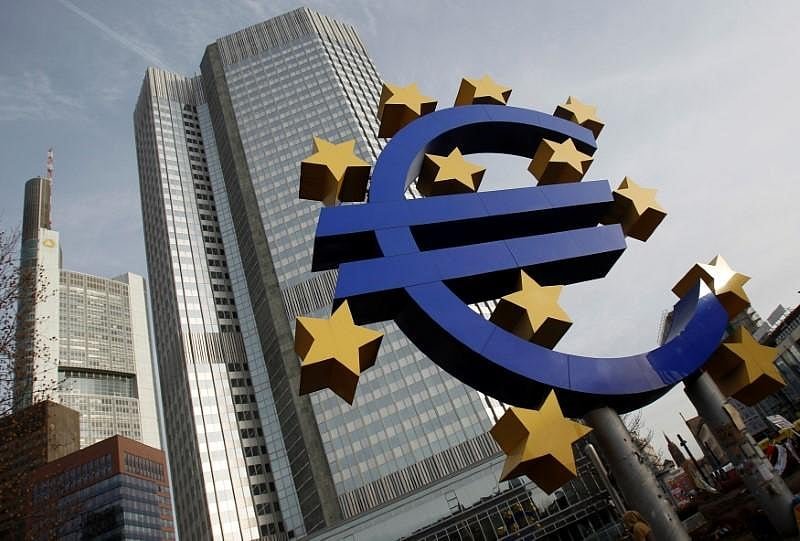
With inflation risks shifting downward and the euro hitting record highs, the European Central Bank may act decisively to maintain price and financial stability.
As global markets grow increasingly volatile and trade tensions mount, the European Central Bank (ECB) finds itself navigating a currency conundrum. The euro’s recent surge against the U.S. dollar — gaining 4% in just one week — has thrown fresh complexity into the ECB’s upcoming policy decisions, prompting speculation about a potential shift in its easing strategy.
While the ECB is widely expected to cut its main borrowing rate by another 25 basis points to 2.25% this Thursday, the central bank’s tone — and the degree of its action — may be more dovish than anticipated. This comes amid a steep drop in the U.S. dollar, sparked by concerns over capital flight, and an unexpectedly strong euro, which hit three-year highs last Friday.
But beyond headlines, deeper currency metrics paint an even more striking picture. The ECB’s nominal exchange rate index — which tracks the euro against 41 trading partners — has reached an all-time high. Meanwhile, the real effective exchange rate, which adjusts for inflation differentials, is now at its highest in a decade.
This dramatic revaluation poses a challenge to the ECB’s primary objective: price stability. While rising currencies can dampen imported inflation — typically a welcome development — the euro’s rapid ascent now threatens to drag inflation below the ECB’s 2% target. And that opens the door to a more aggressive easing cycle.
A Shift from Trade War to Currency War
In the broader geopolitical context, trade tensions risk spilling into the realm of currency manipulation. As the euro strengthens, the Eurozone faces increasing pressure from U.S. tariffs, weakening export competitiveness and growth prospects. President Christine Lagarde highlighted this concern last week, noting that U.S. trade policy could halve euro zone growth this year from the already modest 0.9% forecast.
Speaking in Warsaw, Lagarde emphasized that the ECB is “attentive” to the euro’s exchange rate and stands “ready to use the instruments that it has available” to safeguard both price and financial stability.
Her choice of words — “attentive” — may seem mild compared to former ECB President Jean-Claude Trichet’s famous warning two decades ago about a “brutal” euro rise. But the signal is clear: the ECB is closely watching the currency and may act to curb its ascent.
Tools on the Table
While fiscal stimulus in Germany and elsewhere may help down the line, such measures take time to filter through. The ECB, on the other hand, has more immediate levers at its disposal.
Speculation is already mounting about whether the ECB could cut rates more than 25 basis points, or even pause the ongoing reduction of its bond holdings — a move echoing the U.S. Federal Reserve’s recent strategy. Markets are also eyeing the ECB’s updated guidance, which could steer expectations toward further cuts later this year.
ECB watchers, including Deutsche Bank’s Mark Wall, expect a dovish shift. He notes that assumptions linking tariffs to higher inflation are being upended by other forces — such as stronger currencies, falling oil prices, and the risk of trade diversion — which all weigh on inflation expectations.
Wall forecasts a terminal ECB rate of just 1.5%, and argues the central bank must stay nimble in this “complex and dynamic trade shock.”
Stability First
Despite the growing uncertainty, Lagarde maintained that euro zone financial markets remain orderly for now. The ECB’s systemic stress index has ticked up to its highest level since 2023, largely driven by foreign exchange volatility, but remains far from crisis territory.
Still, the central bank’s track record of acting preemptively when price or financial stability is threatened suggests that further easing may be closer than previously thought. In this environment, leaning against the mounting pressure on the euro may not just be prudent — it may be necessary.
As the ECB meets this week, the euro’s trajectory could define not only the next interest rate move, but the broader strategy for safeguarding Europe’s economic future. Whether the rise is “brutal” or merely “attentive,” the message is becoming clear: the ECB is ready to act.